I didn’t know until recently that Marco Polo’s travels through China during the 13th Century weren’t in fact written down by him. They were dictated to Rustichello de Pisa, whom Polo shared a prison cell with in Genoa. It’s important here to remember that despite Rome being a hugely important empire, after its fall, Italy was not a singular place until the 19th century. Even though Pisa, Genoa, and Venice seem basically neighbors today, that was not the case for most of their respective histories.
When Polo and Rustichello found each other in prison, Venice and Genoa were embroiled in a bitter war as rival maritime powers of the Mediterranean. Polo was captured after leading a battleship against Genoa and thrown in the clink with Rustichello who was captured about a decade earlier during the Genoese-Pisan War. I oversimplified the history because wow, such carnage!
Anyway, for a long period of time a lot of people wondered or outright accused Polo of making all this stuff about China up. He wasn’t the first person to travel there, and his accounts of places and cultures he encountered were so fantastical, many wondered how it could possibly be true. Later, in the 19th and 20th Centuries, academics questioned why he never mentioned basic things the west had come to associate with China: The Great Wall, footbinding, and the Chinese writing system, to name a few. Plus, Rustichello was a romance writer so could we really take him seriously for non-fiction?
Most scholars seem to agree these days that the journeys accounted for in The Travels really happened more or less as the books recounts them. That certainty did not come until 2012, though, so in 1976 when Italo Calvino wrote Hidden Cities, the mystique of Marco Polo was very much still in the air and contributes to what makes his book so clever.
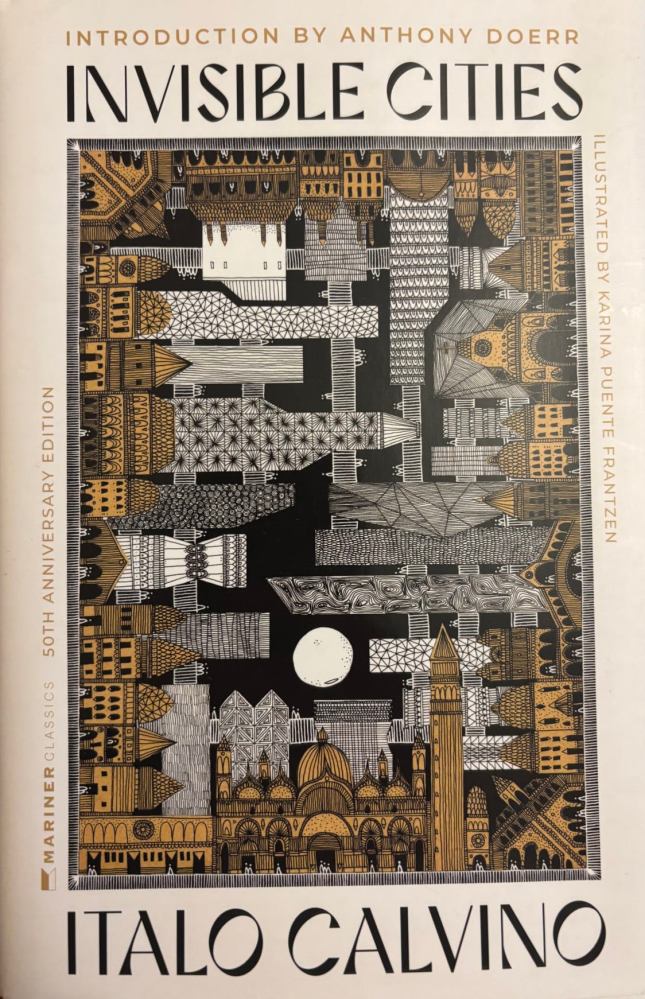
Hidden Cities imagines Marco Polo recounting the places he encountered throughout the Mongol Empire to Kublai Khan, punctuated by conversations between the two men where Kublai is always entertained by Polo’s magnificent stories, even if he can’t quite tell what’s real or fiction.
At one point, Khan asks why Polo never describes Venice, Polo’s home. “Every time I describe a city I am saying something about Venice.” Frustrated by the answer, Khan directs him: “When I ask you about other cities, I want to hear about them. And about Venice, when I ask you about Venice.”
“To distinguish the other cities’ qualities,” Polo says, “I must speak of a first city that remains implicit. For me, that is Venice.”
I loved this exchange because it there’s something essential about the concept of an implicit first city. Whenever we tell someone about our experiences in Seoul, Budapest, Kaposvár, or any other place we visit, we reveal something about ourselves and where we’re from. Maybe it’s an appreciation for an urban tree canopy or desire for better public transit; or a wistfulness, or indifference for something lost when we moved away; or an expression of love for all four seasons, and unique ways they play out at home and away. It’s not nostalgia or even wistfulness, but maybe fear of losing our way in the pursuit of exploration.
Calvino’s challenge to the formalism of the short story, blurring it with prose poetry, also makes this book fun to read. There are all kinds of sentences that don’t appear to make sense until you put the book down, take a walk, or read another chapter dozens of pages later. Calvino himself described the book as a tetrahedron, and it does feel like you could roll a D20 to pick the next chapter you read and it’s patterns would make a whole new kind of sense; revealing new Truths about the institution of the city.
One of my favorite patterns was the city transformed upon entry: Clarice, for example, was transformed by centuries of decay and renewal to the point where the original version of itself is an urban legend; or Leonia, which “refashions itself every day.” Theodora’s inhabitants seem to live everywhere and nowhere at the same time, to the point that they can’t even describe where it is they eat, sleep, or work. And yet, work is done, bellies are full, and minds rested.
Another, cities only visible under certain conditions:
Irene is the city visible when you lean out from the edge of a plateau at the hour when the lights come on, and in the limpid air, the pink of the settlement can be discerned spead out in the distance below: where the windows are more concentrated, where it thins out in dimly lighted alleys, where it collects the shadows of gardens, where it raises towers with signal fires; and if the evening is misty, a hazy glow swells like a milky sponge at the foot of the gulleys.… Irene is a magnet for the eyes and thoughts of those who stay up above.
Reading this book is a humanities course in an urban studies program. It seeks not a unifying theory of how to intervene to rescue cities, or boost economies, or describe the correct conditions for urban problems; nor to help anybody understand how to lay out a transit grid or calibrate a proper housing density. Instead, this book argues every city can be deduced from “a model city…made only of exceptions, exclusions, incongruities, contradictions,” as Polo put it, rather than one which “contains everything corresponding to the norm.”
This is how you get cities like Ersilia where “to establish relationships…inhabitants stretch strings from the corners of houses,” and is constantly rebuilt as the networks of strings become too dense and complex to live among.
It’s how you get a city like Baucis, which cannot be seen because its residents live above the clouds; connected to earth by long ladders so that they may observe the Earth from a reverent distance.
Thekla remains in a perpetual state of construction so that its resident’s can defer its destruction.
What a tremendously fun book. I’m already thinking of ways I can use it as a baseline for creative discovery.