My kid fell out of a tree while he was at a camp this summer. He wasn’t injured but the camp called us about it. Am I a bad parent for sending him to a camp where he could fall out of a tree? We left him with a nanny when he was six months old because to pay the bills required two working parents. Does that make us bad parents? How should the state determine if we should keep our child? These are the questions Jessamine Chan asks in The School for Good Mothers, an astonishing debut novel that gave me nightmares, and yet I couldn’t put it down.
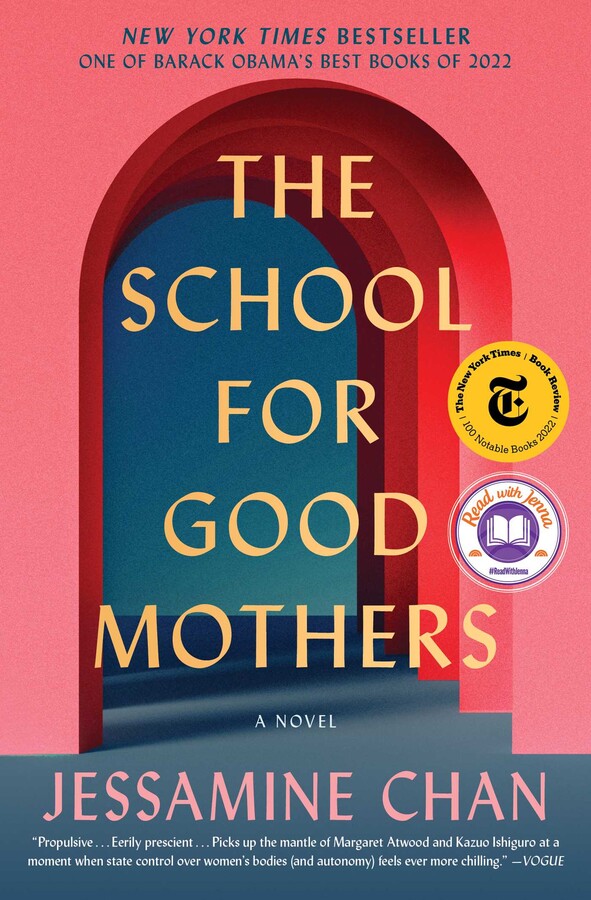
Frida Liu, tho book’s protagonist, is like so many of us middle-aged working millennials: Overworked and overburdened by the endless little things that must be taken care of in order to do the basic job of parenting. Liu makes one (very big) mistake that transforms her from a flawed person to a danger to her child — at least in the eyes of the state.
Chan is among a few artists over the last few years to ponder how modern life expects perfection from parents, mothers in particular, while also setting them up for total failure. The film If I had Legs I’d Kick You and show Maximum Pleasure Guaranteed both rattled around in my head while I read this book; like backstories for Chan’s side characters at the eponymous school.
Each work centers on a mother, actually or ostensibly single, beaten down by the vicissitudes of capitalism and the state’s role in enforcing that perfection. Each story tackles it from a different direction but in all three the institutions and individuals who are meant to support them utterly fail to give them what they need to sustain “good” parenting.
At one point in ‘School‘ Frida asks herself what was so important about her work that led to the very bad choice that landed her in the eponymous not-a-prison re-education institution. It’s clear to the reader: She had no choice. Her job was the only means of earning an income to support everything else she needs to sustain single parenting. In the same way, Rose Byrne’s Linda in If I Had Legs needed to work to provide the expensive medical care her daughter needed and cover the expensive repairs to the hole in their ceiling; Tatiana Maslany’s promotion at work in Maximum was essential to proving to the court she was a competent parent worthy of shared custody with her ex-husband. To choose not to work puts in peril access to health care, housing, and future security because we have no meaningful social safety net in the US. It’s not optional.
Even if it is, work can be mentally refreshing, enlightening, and a way to show your child what it means to take pride and advance a goal larger than yourself. I loved how If I had Legs I’d Kick You and Maximum Pleasure Guaranteed showed their characters doing work. American capitalism betrays that notion by tethering our lives to work. You can only afford health care if you have a job, and only then if that job decides to provide strong benefits. We don’t put nearly enough emphasis on the risk when that employer goes away, lets you go, or you can’t be there for them because your child needs you more.
These three works take a magnifying glass to the state of American capitalism and reveal its ruthlessness. At once, we tell parents they must work to earn the income and benefits required to provide for their family but also that any hour not spent with our children puts them at risk. It’s an impossible paradox colored even further by the extreme constraints we place on what little social safety net we do have. We have a US Government that assumes people who apply for child care benefits are fraudsters. And now, single parents may be excluded from them entirely because they work and are not married.
We already live in the world imagined by these works. The horror is that their worst consequences feel increasingly real, too.
Comments
16 responses to “Parenting in late-stage capitalism”